Horse racing online bookmakers
 |
|
|
|
|
 |
 |
UAE show jumper Qualifies For FEI Championship
-24 Sept 2006
|
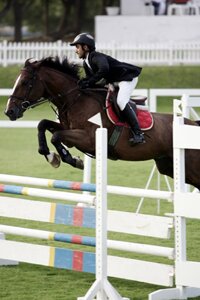 |
Young UAE show jumper Sheikh Ali bin Abdullah Al Qassimi, has been qualified for the Final of the FEI Children's International Competition from Group VII.
Sheikh Ali will be taking part in the final competitions to be held from October 23 to October 29, 2006, in Spruce Meadows, Calgary, Alberta, Canada. He is the only UAE show jumper in Category A to be qualified for this event.
Show Jumpers from many parts of the world took part in the qualifying rounds which were held in different countries over a period of six months starting from February this year.
|
|
|
Sheikh Abdullah, riding the horse Clam de Jonas, qualified during the show jumping competitions held in Sharjah on April 27 and 28 this year. Sheikh Abdullah, who occupies the third position in the UAE show jumpers' ranking in the current year, has shown a lot of promise as an young rider. He finished third in the International Junior Show Jumping Competitions in Bahrain in February. Sheikh Abdullah bin Majid Al Qassimi, Vice-President and Chairman of the Selection Committee, UAE Equestrian and Racing Federation, expressed his profound happiness over the selection of young Sheikh Ali. While thanking the Chairman of the UAE Equestrian Federation, Dr. His Excellency Sheikh Sultan bin Khalifa Al Nahyan, Sheikh Abdullah said UAE is making great strides in the equestrian sports and this could be only possible because of the able support of the Chairman of the Federation who helps youngsters to realize their dreams in all sporting activities.
|
 |
|
Veterinarians attend Interactive seminar -24 Sept 2006
|
|
More than 20 veterinary doctors attended a highly interactive seminar organized by the veterinary department of the UAE Equestrian and Racing Federation to augur the new endurance season which will kick start in the country from November 4 onwards. The seminar was held during the weekend at the Millennium Hotel, Abu Dhabi.
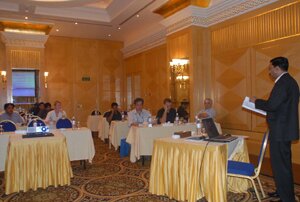
Dr. James Bryant, Head of the Veterinary Department at the UAE Federation, coordinated the proceedings. A wide-ranging topics came under discussions which included FEI passports, update on equine Influenza, veterinary regulation modifications, FEI anti-doping and medication rules, equine prohibited list, introduction of microchip, endurance at championship level and problems encountered in the previous endurance season.
At the outset, Dr. C.V. Niranjan, veterinarian at the Federation, began the seminar with an introduction to the new FEI rules for the issuance of passport for horses. He said the FEI has started issuing passports online from the beginning of this year, hence it is very important that the veterinarians understand and follow the FEI rules clearly. He requested that all details in the application forms should be entered properly in order to facilitate the issuance of passports not only easier but also quicker.
While giving details of the FEI rule change for equine influenza vaccination, Dr. Niranjan said since Equine Influenza is highly contagious to susceptible horses, the FEI Veterinary Committee is annually reviewing the requirements for the vaccination which could be altered if the vaccination or the disease situation changes. According to the amended FEI rules, all horses taking part in the FEI competitions must have received two injections for primary vaccination against equine influenza, given between 21 and 92 days apart. Thereafter booster vaccinations must have been given within every six months + 21 days (bi-annual vaccinations). No vaccinations must have been given within seven days of the competition.
Giving details about the introduction of microchips, Dr. Niranjan said the UAE Federation is planning to set up a data base, procure microchips and distribute them to the stables. This matter will be studied during this season, he said.
Dr. James Bryant, while taking up the issue of Anti-doping regretted that more and more positive cases were being disclosed during FEI events around the world, 'which is not good for the image of equestrian sport.' He said doping or attempting to influence the performance of the horses during endurance or a show jumping event is highly unacceptable. The FEI has issued guidelines for treating and team veterinarians "with the objectives to protect the welfare of the horse, defend the integrity of the sport and to reassure the public."
While stating that there has been an increase in sanctions on individuals for violating anti-doping rules, Dr. Bryant stated that for the first violation, the penalty is up to two years' ineligibility/ban from participating in any rides. For the second violation, be it anti-doping rule or medication control violation within five years of notice of the first violation, up to a four-year ban from competitions may be imposed. Keeping the heavy sanctions in mind, Dr. Bryant stated that "as veterinarians we need to look carefully when we are asked to do certain things."
Many of the participants felt that there was a need for a media campaign as far as the endurance sport was concerned. They felt the sport was not getting the proper exposure it deserved as many people tended to get confused between various equestrian games in general and endurance sport in particular. They felt the general public should be educated about the endurance sport which has specific guidelines, rules and regulations, and most of all, a really challenging event.
In addition, the participants also discussed some case histories relating to the previous endurance season, problems faced by the veterinarians during the past season and how they could be overcome and endurance at championship level.
|
|
| Sheikh Hamdan's colt Champion at Newmarket -20 Sept 2006 |
|
Three-year-old pure-bred Arabian horse Naphir, owned by Sheikh Hamdan bin Rashid Al Maktoum, UAE Minister of Finance & Industry, flashed past the winning post a length and half to clinch the Abu Dhabi International Championship at Newmarket racecourse, on Tuesday, September 19, 2006. He was ridden by French jockey Charles Nora and trained by Damien De Watrigant.
Second place went to Belgium entry Froda ridden by Koen Clijmans and the third place went to CS Charma trained by Bill Smith and owned and bred by David Brunton.
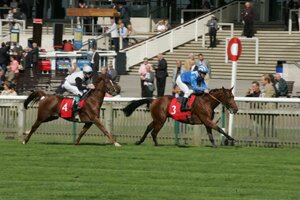
Naphir, owned by Sheikh Hamdan bin Rashid Al Maktoum, at the finishing
point at the Newmarket Racecourse on Tuesday.
Sheikh Hamdan's promising horse made a debut win at Pompadour, France in July. Richard Lancaster, the Stud Director of Sheikh Hamdan's "Shadwell Estate" said it was a last minute decision to run the colt at Newmarket as he was still inexperienced and they were not sure how he would cope with the long journey from the south west of France.
Naphir made all the running in the hands of the Charles Nora. Simon Walker on CS Charma showed good form too initially but the challenge was short-lived. The Belgium horse bred, owned and trained by Johan Verstrepen was the most experienced runner with five previous starts. But it was evident he could not match Naphir who won the race effortlessly.
The UAE Equestrian & Racing Federation Nursery Handicap, for two-year-old Thoroughbreds, was a thriller as four runners filled the photo finish. The field of nine were tightly bunched as they raced over a mile on the glorious turf of the Newmarket course. The eventual winner King Charles completed a hat-trick for trainer Ed Dunlop and owner Khalifa Sultan. Second-placed Zafonical Storm set the pace as he ran on his own in the centre of the course. Third-placed Bid For Glory mounted his challenge two furlongs out and kept on strongly to finish a short head in front of the filly Guacamole who held the lead two furlongs out but was just caught at the finish.
Both the races were sponsored by the UAE Equestrian and Racing Federation, which organises races for Pure-bred Arabian horses in Europe and North America as part its strategy to boost this breed. Races for the season began in July in Newmarket and moved over to Deauville, France, Curragh, Ireland, Ostend, Belgium, Delaware Park, USA, Duindigt, Holland, Moscow, Russia and the curtains will come down in Baden Baden, Germany in October.
|
|
|
|
|
|