|
The Veterinary department of the Federation has an active and varied role to play in the growth and welfare of the equine sporting industry. The activities of the Veterinary department include the following
 Providing veterinary coverage during all sporting events both within the UAE and whenever called for in overseas centers. This includes Endurance, Show Jumping, Dressage and Racing. Providing veterinary coverage during all sporting events both within the UAE and whenever called for in overseas centers. This includes Endurance, Show Jumping, Dressage and Racing.
Providing all registered horses with proper documents.
Working jointly with the UAE Ministry of Agriculture and Fisheries as members of the Higher Technical Committee to evolve guidelines to protect and raise the level of equine health in the country.
Offering guidance and advice to all its members to ensure optimum health status of horses in the country.
Offering assistance to all members in educating them on the modalities of import and export of horses.
Conduct study and research in various aspects of equine sports in order to ensure optimum equine health and safety.
Providing veterinary coverage during all sporting events both within the UAE and whenever called for at overseas centers.
A number of equine sporting disciplines are popular in the UAE. Veterinary officials deputed by the Federation are always available to provide all necessary assistance.
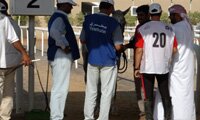
Most of our endurance rides are held in three major villages specially constructed for this sport with well-equipped clinics. During all events, these clinics are manned by experienced clinical veterinarians.
During the ride, the Veterinary Commission will advise the person responsible to present the horse to the clinic if required for suitable treatment. Horses requiring major treatment and hospitalization are referred to the Equine Hospital.
The Show jumping competitions are held at various Equestrian Centers.
MEDICATION CONTROL PROGRAMME
During all our events, it is ensured that at least five per cent of participating horses in Endurance rides and International Show Jumping Competitions are subjected for Medication Control Program. Both the Urine & Blood are collected as per procedure laid down by the FEI. The samples collected are then sent to the Central laboratory approved by the FEI.
VACCINATION IDENTITY DOCUMENT
This is an Identity document approved by the UAE National Federation. It contains all the relevant information of a horse including its diagram, age, color, sex and Equine Influenza vaccination details.
Passport Requirement:
For rides of CEI.3* and above all horses must be presented for veterinary inspection with an original FEI Passport /FEI approved National Passport along with FEI Recognition Card with up to-date equine influenza vaccination record.
For rides of CEI.2* and CEI.1* FEI passport is not required if competing in their country of residence. Horses can be presented with an FEI approved passport or a duly authenticated UAE Equestrian and Racing Federation Vaccination Identity Document with up-to–date influenza vaccination record.
Horses can be presented for all National Competition Rides & Federation Qualification Rides with an approved passport or a duly authenticated UAE Equestrian and Racing Federation Vaccination Identity Document with up-to–date influenza vaccination record.
FEI PASSPORT
I. COMPLETION OF PASSPORTS
1. A passport, which must be extended every four years, must remain with the horsethroughout its life and must accompany it at all times.
2. National Federations are responsible for issuing FEI passports and must transmit the following information to the FEI before they receive the FEI passport number:
2.1 original horse name, and/or current horse name
2.2 UELN and/or MICROCHIP number;
2.3 sex, colour and date of birth of the horse;
2.4 name, nationality and address of the owner(s);
2.5 copy of the description/diagram;
2.6 studbook or breed or country of birth
In the UAE, the FEI Passports are issued by the UAE Equestrian Federation. It is mandatory to have a previous identity document of the horse to request for a FEI Passport. At the time of request, if the horse is not yet registered in FEI & is holding a national passport / VID document, you can change the name of the horse at no extra cost. The Passport will be issued in the new name.
If the horse has already registered in FEI with the National passport & has taken part in FEI events, to change the name of the horse at this juncture will incur a fee of AED 3700 ( as on 1st Jan 2009).
To obtain a FEI passport, with the introduction of FEI online registration of horse before issuing a passport, the owner must furnish all the mandatory information in the application form.
On receipt of the application, the Federation will enter all the mandatory information on to the FEI system. The FEI will check its database for duplicates and will issue a passport number for that particular horse. The details of the horse are then endorsed on to the passport and will be issued to the owner.
Passport completion:
On receipt of the passport by the owner,
- The owner's signature must be affixed in the relevant column.
- The diagram & the description page must be completed with all distinguishing marks/whorls described satisfactorily by the National Federation approved veterinarian.
- The Equine Influenza vaccination details must be entered and endorsed by the veterinarian.
The schedule for Equine Influenza vaccination as laid down by the Federation Equestre Internationale in Annexe VII of their Veterinary Regulations 2006 is as follows;
1. Primary course of vaccination: Two doses of vaccine have to be administered between a minimum of 21 days to a maximum of 92 days apart. 2. The first booster vaccination must be given no more than 6 months + 21 days after the second vaccination of the primary course. A shorter interval is obviously permitted.
3. Booster vaccination: Booster vaccinations must be given at every 6 months intervals. However, to avoid the interruption of the horses' competition schedule, it is permissible to extend the 6 months booster date by a maximum of 21days.
4. None of these injections may be given within seven days of any sporting event. In calculating the days, the day of injection is excluded
In the event of any disruption in the afore-mentioned vaccination schedule, the vaccination has to be restarted from two primary vaccinations. Please note that if the horses are not vaccinated as per the rules, the FEI will impose a fine and may even remove the horse from the site. For the further details on the penalty imposed, please refer the following links.
Guidelines for Equine Influenza
EQUINE INFLUENZA VACCINATION
From 1 January 2005 onwards, influenza vaccination for all horses competing in FEI competitions requires a vaccination within six months + 21 days of the competition.
1. All horses intending to participate in FEI competition must have at least received an initial primary course of two vaccinations, given between 21 and 92 days apart. Thereafter, a third dose (referred to as the first booster) must be given within 6 months + 21 days after the date of administration of the second primary dose, with at least annual boosters given subsequently (i.e. within one year of the last dose).
2. If the horse is scheduled to take part in an FEI competition, the last booster must have been given within 6 months + 21 days of arrival at the FEI event. (The 21day window has been provided to enable vaccination requirements to fit in with the competition schedule).
3. No vaccination shall be given within 7 days of the day of arrival at the FEI event.
4. All horses that were certified as correctly vaccinated under the previous FEI equine influenza vaccination rule prior to 1st January 2005, do not need to start a primary course again provided that they have complied with the previous rule of primary course and annual re-vaccinations and the new rule of a booster vaccination within 6 months + 21 days of the day of arrival at the FEI event.
Vaccines, Administration and Certification
• All proprietary equine influenza vaccines are acceptable to the FEI irrespective of the route of administration.
• All vaccines must be administered by a Veterinarian.
• The vaccination should be administered according to the manufacturer’s instructions, (i.e. intramuscular injection or intranasal).
• The details of the vaccine, serial/batch number, the date and route of administration must be recorded in the FEI passport.
• Where vaccination details are to be entered into new FEI passports/recognition cards or duplicates, if the vaccination history of the horse is very long, the Veterinarian who completes the descriptive page of the passport/recognition card may use a specific statement to certify that the vaccinations have been administered in accordance with FEI regulations (for the extract of the wording see Veterinary Regulations, Annex XIII.I.11).
Sanctions
As from 1 January 2006 a system of fines is being imposed by the Appeal Committee/Ground Jury for failure to comply with 6month booster vaccination prior to event arrival.
o Less than one week after the 3-week vaccination window: CHF 200
o Less than two weeks after the 3-week vaccination window: CHF 300
o Less than four weeks after the 3-week vaccination window: CHF 400
o More than four weeks after the 3-week vaccination window: CHF 500, and
cancellation of the horse’s participation in the event.
• If there is no evidence of any current vaccination in passport: or if the period at any stage is more than 12 months a maximum penalty of CHF 500 can be imposed. The horse should not be allowed to compete. It must be put in isolation and sent away from the event as soon as possible.
• Provided the current passport contains a statement that the vaccination history of the horse has been checked and found to be correct (for exact wording see VR, Annex XII.I.11), the lack of information available on the primary vaccination course need not lead to a penalty, and a repeat primary course is not required.
For horses starting vaccinations after 1st January 2005, when the first booster has not been given (6 months +/- 21 days after the second injection of the primary course), the horse should receive a new primary course followed by a booster vaccination 6 months (+/- 21 days) later. A warning should be written down in the passport. The horse may compete providing that it complies with the rules in every other way.
• Any infringements of vaccination dates should be noted on the vaccination page in the passport so that it is not reported again at a future event. Please write in CAPITAL letters; remember that others will be dependent on the information that you have written in the passport. If possible, add a copy of the vaccination page with the infringement to your Vet Report to the FEI.
After completing the description and the diagram, it should be returned to the Federation for validation.
FEI Passport Re-validation:
FEI Passports are valid for 4 years. So they must be re-validated every four years. On submission and payment of the re-validation fee, the Federation will affix the re-validation sticker and stamp, which will there-by extend the validity of the passport by a further four years.
HORSE PASSPORTS
I. COMPLETION OF PASSPORTS
1. A passport, which must be extended every four years, must remain with the horsethroughout its life and must accompany it at all times.
2. National Federations are responsible for issuing FEI passports and must transmit the following information to the FEI before they receive the FEI passport number:
2.1 original horse name, and/or current horse name
2.2 UELN and/or MICROCHIP number;
2.3 sex, colour and date of birth of the horse;
2.4 name, nationaliy and address of the owner(s);
2.5 copy of the description/diagram;
2.6 studbook or breed or country of birth
3. National Federations are also responsible to transmit the following changes without delay:
3.1 change of the National Federation administering;
3.2 change of owner and nationality;
3.3 change of name of the horse or the addition of a second (commercial) name;
3.4 changes in the description and diagram page, (e.g. castration);
4. The horse must be present when the description and the marking of the diagram in the passport is completed. Only veterinarians approved by the National Federations are authorized to complete this page and the description must be in accordance with the FEI booklet on Identification of Horses.
5. The National Federation is required to enter name and address of owner(s) of the horse and the owner must sign the passport where specified. (Please refer GR Art. 139). National Federations should also be aware of European Commission or other national or international legislation relating to identification of horses.
6. National Federations must inform owners that they are responsible for any special entries required to be made, such as recording the full equine influenza vaccination history of the horse (see point 11) in accordance with the ruling currently in force. The vaccination history entered in the passport must be dated, stamped and signed by the veterinarian who vaccinated the horse.
7. The passport completed by the National Federation approved veterinarian must be returned to the National Federation to be checked, authenticated by the signature of an official of the National Federation and the National Federation official stamp and be recorded by National Federation.
8. For passports and recognition cards, National Federations are obliged to make two copies of the description diagram, retain one and send the second copy to the FEI for registration and record purposes.
EXTRACTS FROM GENERAL REGULATIONS
23rd EDITION
Article 137 - HORSE PASSPORTS
1. Every Horse entered for any Competition at CNs or CIMs (see Appendix E) in a foreign country (see GRs 139.2), and all Horses entered for other CIs, CIOs, FEI Championships, Regional, Olympic Games and Paralympic Games, whether at home or in foreign countries (see GRs 141.2), must have an official, valid FEI Passport, or a National Passport approved by the FEI and accompanied by an FEI Recognition Card and, when applicable, must be registered with the FEI, as a means of identification and to establish ownership.
2. Horses taking part in CNs and CIMs, 1* (see Appendix E) in their country of residence are not required to have such a passport as is mentioned in paragraph 1. All such Horses must be properly registered and identifiable and, unless there is no national requirement for equine influenza vaccination in the host country and in the country of origin all Horses must have a valid vaccination certificate.
3. All FEI and/or National Passports must include the full name, address and signature of the Owner as registered by the NF. The description of the Horse and the diagram must be accurately completed, and the FEI and/or National Passport must include a record of all vaccinations and medication control tests. Whenever the name of a Horse with an FEI and/or National Passport is changed, or any pertinent changes are made to an FEI and/or National Passport, the NF must notify the FEI.
4. NFs are responsible for issuing FEI Passports and FEI Recognition Card for all Horses required to have them and for ensuring that the FEI and/or National Passports are correctly completed, as specified in the Veterinary Regulations, prior to being authenticated by the stamp of the NF and the signature of an Official of the NF. NFs must provide the identification page to the FEI for registration. The Person Responsible for a Horse at an Event is responsible for the accuracy of the FEI and/or National Passport and for presenting it at
the Passport Control, except for Events with borrowed Horses (Art.111) where it is the responsibility of the host NF.
5. A Horse may only have one FEI Passport or one National Passport with an FEI Recognition Card as per paragraph 1 of this Article and one permanent FEI number. If an NF is satisfied that an FEI and/or National Passport has been lost or if any section of the FEI and/or National Passport is full, it may issue an FEI and/or National Passport clearly marked "duplicate" and bearing the same number as the original FEI Passport. The issue of a duplicate FEI and/or National Passport must be reported to the FEI (see VRs).
6. OCs must arrange for each Horse to be positively identified at the Passport Control during the examination on arrival, in accordance with the VRs. Any case of misleading or inaccurate information in an FEI and/or National Passport, or if the Horse cannot be positively identified, must be reported to the President of the Appeal Committee, who must report the case to the Secretary General, giving the number of the FEI and/or National Passport with the FEI Recognation Card and the name of the Horse.
7. If any Horse arrives at a CI, CIO, FEI Championship, Regional Games or Olympic Games without an FEI and/or National Passport with an FEI Recognition Card, or if its FEI or National Passport is inaccurate, it must not be allowed to compete unless the Appeal Committee (or the Ground Jury if there is no Appeal Committee) gives its Approval. Only in exceptional circumstances may a Horse without an FEI or National Passport or without an FEI Recognition Card be allowed to compete.
8. All Horses taking part in FEI Events must be registered with the FEI.
Article 138 - NAMES OF HORSES
1. In principle, the first registered name of a Horse entered in the passport shall be the original name under which it was originally registered by its NF, and this name must remain permanently in the passport.
2. The first registered name may not be the name of a commercial company or product. If this name is considered to be the name of a commercial company or product, a new first registered name must be entered and remain permanently in the passport.
3. A commercial prefix/suffix may be added to the name mentioned in paragraphs 1 and 2 above, and must be entered in the passport. However, at Regional and Olympic Games under the patronage of the IOC, such prefix/suffix cannot appear in a programme or be used in any other way.
4. If a new first name shall be used and entered in the passport and/or the commercial prefix/suffix be changed, the Horse must carry the new name and/or the new prefix/suffix for the next 12 months as follows: new name and/or new prefix/suffix ex previous name/prefix/ suffix (see VRs).
Article 139 - OWNERS AND LESSEES OF HORSES
1. NFs must keep a register of the Owners and lessees of Horses with official passports. Changes of Owners and records of Leasing Agreements must be entered in the FEI and/or National Passport and authenticated by the stamp and signature of an official of the NF.
2. The nationality of a Horse is that of its Owner or of the lessee, where a lease is current, or of the country in which the company owning or leasing it is registered. A company may, however, own a Horse in partnership with an individual, see paragraph 3.
3. When one or more Horses belong to a partnership of Owners of different nationalities, the Owners must declare to the FEI, before making the first entry, the nationality under which the Horse or Horses will compete and that nationality must be entered in the FEI and/or National passport. The Horses must retain that nationality until the partnership is dissolved or the Horses are sold. Any consequent change of nationality must be reported to the FEI.
4. Horses entered for the Olympic Games must be the property of Owners of the same nationality as the Athlete by 31st December of the year preceding the Games (see Olympic Regulations).
5. Athletes may take part in all Competitions except Olympic Games with Horses
belonging to Owners of a different nationality (see also Art. 118 Person Responsible).
9. Owners
9.1. Residents abroad and whose horses are kept in their country of residence must apply to the National Federation of their country of residence for passports, in accordance with the procedure laid down in this section. The National Federation of the owner's country of residence must inform the owner's home National Federation of such action.
9.2. Owners living in their own country and whose horses are kept in a foreign country must apply to the National Federation of the country where the horses are kept for the issue of a passport or the validation of a national passport with recognition card.
10. The passport should be held by the Person Responsible or the person accompanying the horse, but it must be returned to the National Federation for endorsement in the following cases:
11. Vaccination history: The horse’s vaccination history has to be checked by an approved National Federation’s veterinarian and, if correct, the following statement may be used:
"The vaccination history of this horse is correct to date. Last vaccination on ... (enter date)" in the cases mentioned bellow:
• Newly issued passports
• Duplicates
The veterinarian authenticating such a statement has to be the same who filled in the description and diagram pages.
II. NATIONAL PASSPORTS
1. National Federations or National Equestrian Authorities that issue their own passports may apply to the FEI to have their passports approved for use instead of the FEI Passport.
The names of countries for which National Passports have been approved will be published in the FEI Bulletin.
2. The completion of approved National Passports must be in accordance with the procedure as laid down in section I. (see FEI booklet Identification of Horses, 5th edition)
3. Following approval, National Passports become International with the addition of an FEI plastic cover and recognition card. Only with such a cover and valid recognition card may a horse compete internationally.
4. At least the sex and colour of the horse must be completed in one of the official FEI languages; it is strongly recommended that for the description of the horse the English language is used.
III. CHANGE OF OWNERSHIP AND NATIONALITY
When a horse is sold to an owner of another nationality, the new owner must send the passport to his National Federation for registration and recording as required in section I.
The new National Federation is responsible for informing the FEI, and the original National Federation, of the change of ownership and nationality.
IV. CHANGE OF NAME
1. When the name of a horse is changed, the owner must send the passport to his/her National Federation for recording. The National Federation is responsible for registering the change of name which must be stated in the FEI passport.
2. The Original Name of the horse entered in its passport is the name under which it is first registered with its Studbook National Federation. If the horse's name has been changed before it receives an FEI or FEI Approved Passport, the Original Name must be entered first and must be retained as the Original Name throughout the life of the horse. The name must have three letters at least.
V. ISSUE OF DUPLICATE PASSPORT
1. If a passport is lost or irreparably damaged, or if some or all pages are fully completed, a passport marked duplicate may be issued by the National Federation following the procedure in section I (see FEI booklet Identification of Horses 5th edition). The period of validity of the duplicate passport will be for the remaining period of validity of the original passport. The horse retains the same passport number that must be entered by the National Federation in the duplicate passport.
2. If the original passport is found, both passports must be returned to the appropriate National Federation. The original passport will be reregistered and returned to the owner.
The duplicate passport is to be destroyed and the FEI duly informed.
VI. EXTENSION OF HORSE PASSPORTS
1. Horse/pony passports are valid for four years after which period they require a
revalidation sticker affixed to the front page. Revalidation stickers must indicate the passport number and the expiry date of the sticker.
2. National Federations must order revalidation stickers from the FEI.
3. The validity of the revalidation sticker must be four years.
4. National Federations should make every effort to ensure that Persons Responsible obtain revalidation stickers from their National Federations in due time before their horses compete.
5. The control of revalidation stickers is part of Passport Control conducted by the Veterinary Commission/Delegate at all international events.
6. If a passport does not contain the relevant revalidation sticker the Veterinary
Commission/Delegate will instruct the Person Responsible to purchase a revalidation sticker within the succeeding 30 days. This fact will be recorded in the passport and also in the Veterinary Report. The horse will be allowed to compete during this period without penalty.
However, unde no circumstances will it be permitted to do so following the expiration of the 30 days unless the passport has been correctly extended in the interim.
Change of Ownership:
Any change in the ownership of the horse with a passport must be duly recorded with the Federation. A letter confirming the sale issued by the erstwhile owner/ the application for transfer of ownership (available with the Federation & website) must accompany the passport for updating our records. The necessary endorsement would be done in the passport and returned to the new owner.
Change of horse Name:
If an owner wishes to change the name of his horse, the passport must be submitted to the Federation with an application form for Change of horse name (available with the Federation & website).
Duplicate passport:
Duplicate passports are issued only in the following cases:
- all sections in the passport are completely filled:
- passport is damaged or
- Passport is lost.
In such an event, a letter requesting for a duplicate passport must be submitted by the owner (together with a copy of the passport). On receipt of this letter, together with the necessary payment, a duplicate blank passport (which will bear the same number as that of the original) will be issued for completion. The same procedure as mentioned under 'passport completion' will have to be followed.
Change of nationality:
The nationality of the horse is always that of the owner. In case of joint ownership where the joint owners are of different nationalities, they must arrive at a decision to declare the nationality of the horse. The nationality of the horse in such cases will be that of one of the joint-owners.
Article 118 - PERSONS RESPONSIBLE
1. The Person Responsible for a Horse has legal responsibility for that Horse, including responsibility under the GRs and the VRs and unless otherwise stated is liable under the Legal System (Chapter IX).
2. It is the obligation of the Person Responsible and of every other person subject to the Statutes, GRs and Sport Rules to know the Statutes, GRs and relevant Sport Rules, and lack of such knowledge does not relieve these persons from liabilities under the Statutes, GRs and Sport Rules.
3. The Person Responsible shall be the Athlete who rides or drives the Horse during an Event, but the Owner and other support personnel including but not limited to grooms and veterinarians may be regarded as additional Persons Responsible if they are present at the Event or have made a relevant Decision about the Horse. In vaulting, the lunger shall be an additional Person Responsible.
4. Athlete under 18 years of age:
4.1 . If the Athlete is under 18 years of age when the entry is submitted, the NF or Chef d’Equipe must nominate a representative for the Athlete.
4.2 . The representative may be a parent of the Athlete, the Chef d'Equipe, the team coach, the team veterinarian, the Owner or some other responsible adult and shall be communicated to the OC and the NF with the entry.
4.3 . If the NF and Chef d’Equipe fail to nominate the representative, either parent of the Athlete may be considered as the representative.
4.4 . The minor Athlete shall remain the Person Responsible.
4.5 . The representative may represent the minor Person Responsible in all dealings with the OC, the NFs and the FEI Officials, including, but not limited to, witnessing the medication process.
4.6 . When the representative is from another NF than the Person Responsible’s, all communications shall take place through the Person Responsible’s NF.
5. The Person Responsible, together with the Chef d’Equipe if present, is responsible for the condition, fitness and management and for declaring or scratching of each and every Horse under his jurisdiction.
6. The Person Responsible is responsible for any act performed in the stables to any Horse under his jurisdiction, by himself or by any other person with access to the Horse, and is responsible while riding, driving or exercising any Horse under his jurisdiction. The Person Responsible is not relieved from such responsibility as a result of the lack or insufficiency of stable security.
7. If, for any reason, the Person Responsible is unable or is prevented from caring for the Horses under his jurisdiction he must immediately notify the Secretary of the OC and the Veterinary Commission.
Article 142 - ABUSE OF HORSES
1. No person may abuse a Horse during an Event or at any other time.
2. Any person witnessing an Abuse must report it in the form of a protest (Art 163) without delay. If an Abuse is witnessed during or in direct connection with an Event, it should be reported as a protest (Art 163) to an Official. If the Abuse is witnessed at any other time it should be reported as a protest (Art 163) to the Secretary General for referral to the FEI Tribunal.
Article 155 – STEWARDS
1. OCs of all International Events must appoint a Chief Steward and an appropriate number of Stewards under the authority of the Chief Steward, wearing distinctive identification such as badges, arm bands, bibs, etc, with complete freedom of access to all areas mentioned in paragraph 3 below.
2. OCs are responsible for all administrative matters relating to the Appointment of the Chief Steward and the Stewards.
3. During the whole Event in every part of the stables, in exercise and schooling areas, collecting rings and all other areas under control of the OC, the Chief Steward and the Stewards officiating with him at the Event shall:
(i) assist the Athletes in conducting reasonable training;
(ii) intervene in time in order to prevent any abuse of Horse by riders, grooms, owners or any other person;
(iii) intervene in order to prevent any contravention of the Statutes, GRs or Sport Rules or of the common principles of behaviour, fairness and accepted standards of sportsmanship;
(iv) be familiar and assist with doping and medication control procedures.
4. One Steward must be on duty at the collecting ring whenever it is in use.
5. Any irregularities must be reported immediately by the Chief Steward to the President of the Ground Jury.
6. The Chief Steward is required to send a report to the Secretary General on the
stewarding of the Event as a whole and on any incident which occurs during that Event. A copy of the report must be given to the Technical Delegate and to the OC of the Event.
7. The Chief Steward must be a person experienced in equestrian sports, particularly in the Discipline of the Event where he is appointed to officiate. He must speak at least one official language of the FEI. The name of the appointed Chief Steward must be published in the schedule and in the programme of the Event.
8. The FEI maintains a list of all qualified FEI Stewards who have been recommended by their NFs and accepted by the relevant Technical Committee. The Chief Stewards must be selected from the appropriate list of FEI Stewards.
9. The qualifications for an FEI Steward are specified in the Sport Rules of each Discipline or in the FEI Stewards Manual.
10. The NFs must appoint a Steward General in order to maintain communication with the FEI on stewarding matters. The FEI maintains a list of all Stewards General.
11. The Steward General must:
(i) attend an FEI seminar for Steward Generals;
(ii) direct and control the stewarding of all International Events organised in his country.
12. Stewards are Event Officials
Working jointly with the UAE Ministry of Agriculture and Fisheries as members of the Higher Technical Committee to evolve guidelines to protect and raise the level of equine health in the country.
The Secretary General and the Veterinary Officer of the Federation are members of the Higher Technical Committee operating under the auspices of the Ministry of Agriculture and Fisheries. Matters relating to equine health status are dealt with and guidelines are formulated. These guidelines, among other issues, determine the scope of movement of horses to and from the UAE and quarantine regulations.
Offering guidance and advice to all its members to ensure optimum health status of horses in the country.
The UAE has been declared a disease-free zone. Every effort is being taken by the Ministry of Agriculture and Fisheries, Government of UAE, to maintain this optimum state of equine health in the country. The Federation on its part also imparts advice to its members to take all possible care of their horses. From time to time, circulars and bulletins are being sent to all members and stables advising on the need to vaccinate their horses to avoid spread of diseases.
Offering assistance to all members in import and export of horses in educating them on the modalities of.
Many of our members import horses from various overseas centers. Similarly horses from the UAE are also exported to overseas centers. Such shipments could be for participating in sporting events or otherwise. We offer guidance to all on the modalities and requirements for such import and export shipments. The Department of Animal Welfare, Ministry of Agriculture and Fisheries is the best source for up-to-date rules and regulations.
BEST CONDITIONED HORSE COMPETITION
The Best conditioned horse competition is organized for the first 10 horses to cross the finish line within 1 hour from the first finisher. Among those, if any one of them is eliminated at the final vet gate by the veterinary commission or if the heart rate doesn't come down to the stipulated parameter, that particular horse will be automatically disqualified from entering into the Best Condition competition.
The Panel of FEI Judges consists of veterinarians and members of Ground Jury evaluate the horses based on the following parameters.
A. Metabolic assessment
I. Recovery Rate- The time taken by the rider to present his horse at each vet gate after arrival is recorded in the Vet Card. The average of this presentation time( vet In time) is calculated and awarded points from the table printed in the BC form.
II. Heart rate (Cardiac recovery Index score)- The difference between pre and post heart rate at each vet gate is recorded in the Vet Card. The average is calculated and awarded points from the table printed in the BC form.
III. Hydration- The following four parameters are checked during the BC competition-
a. Skin-testing (in terms of seconds)
b. Capillary refill (in terms of seconds)
c. Mucus membrane (in terms of grading- A, B, C & D)
d. Gut sounds (in terms of grading- A, B, C & D)
Points are accordingly awarded and the average is derived.
B. Lesions and Soundness
I. Lesions - The following three parameters are checked during the BC competition -
a. Girth, saddle, tack
b. Limbs
c. Mouth
Points are awarded depending on absence of lesions, presence of mild lesions, moderate lesions. Severe lesions would result in the elimination of the horse.
C. Quality of Movement
I. Attitude - Points are awarded by the panel of judges depending on their reading of the horse's general appearance, brightness and demeanor.
II. Action - Points are awarded by the panel of judges depending on their reading of the horse's willingness to trot, impulsion and rhythm.
The average of the two (I and II) is calculated and awarded to the horse.
D. Finish Time Bonus
The top Finisher is awarded a maximum of 10 points. The remaining contenders are awarded points based on time of finish behind the winner using computer programmed formula. The contenders are then ranked depending on the total points scored.
|